I’ve been managing engineering teams for a while now. One perennial challenge is the constant context switching. Paul Graham wasn’t kidding about the reality of manager schedules, and I spend all day bouncing between wildly different meetings. It’s a lot of little things to keep in working memory. If I don’t write it down, it disappears. Of course, if I do write it down it may still fall into the /dev/null of my Obsidian notebook.
About four years ago, I moved from Notion to Obsidian. I copied some templates I found online and began customizing. Then I kept customizing. Then I found I could write Javascript in Dataview queries and fell down the rabbit hole hard. I had an elaborate system that could track everything.
It was a thing of beauty.
I was terrible at keeping up with it.
The Gap Between Design and Execution
I enjoy designing systems. I also routinely fail at executing them consistently. Take the daily notes. There’s a section for end-of-day reflection that should take 5 minutes. Take a wild guess just how often that got filled in.
Weekly planning was worse. The weekly note has a table for tracking project goals and results. It requires taking a thorough inventory of everything going on and figuring out what needs to happen next. It takes about an hour. When you’re pressed for time, it’s as crucial to have as it is impossible to carve out time for.
So I had this vault full of beautifully designed structure that was only intermittently filled. The bones were solid. The flesh was… not.
Then I Pointed Claude at the Folder
A few weeks ago I started using Claude Cowork. I pointed it at my vault, and something magical happened: all that structure I’d designed but couldn’t consistently maintain suddenly had someone to do the grunt work.
Every morning, I start a Cowork task: “plan my day.” Claude then does all the things I never could do reliably. It checks my calendar, runs a script to pull today’s tasks notes and context, and then synthesizes it into a plan. The daily planning that I’d skip half the time now just happens. It usually ends with Claude yelling at me for having too many meetings, but eh, that’s life.
Throughout the day, I take notes in meetings, set up tasks for later and track my progress. My problem was always finding that information later and tying it all together, which Claude is great at.
End of day, I say “write my wrapup.” Claude looks at what I had planned and what actually happened, and drafts the summary. I edit it (sometimes heavily) but the activation energy dropped from “ten minutes of context-gathering followed by writing” to “review and tweak something decent.” That’s the difference between doing it and not doing it.
Even on my busiest days, having a plan to execute against brings focus and helps me know I’m making progress. It’s a clear-eyed view of what I can expect to accomplish and how to prep for it. The wrap-up in the evening is good for orienting myself and closing out the day. I know where to pick up tomorrow and it’ll highlight things I may have missed in all the context switching between meetings.
My Inconsistency Was Actually Fine
The best part is that the system doesn’t need to be perfectly maintained to be useful. It just needed to be well-designed.
Consistent file naming patterns mean Claude can find things I haven’t touched in weeks. Tagging lets Claude find all the various threads of a project if I need to know what’s going on.
I can give a concrete example: I’m kicking off a project to add a new data integration at Crayon. We’ve been talking about it since I started – what it’d be like in the product, what data we’d need, and which providers we could use. I have notes spanning 18 months that Claude was able to find, ingest, and give me a pretty okay plan for how to run the project. I still had to edit it quite a bit, but it saved me a huge amount of time and effort finding those pieces.
To help with the daily notes, I wrote Python scripts to pull some of the data automatically. This cuts down on the notes it has to scan and controlling that context means better, faster results. The structured files help here, letting me find exactly what I need.
All that time in the rabbit hole of productivity procrastination, turned out to be exactly the right investment! Definitely not going to learn my lesson there.
The Vicious Cycle, Broken
Executive function and stress can form a vicious cycle. You’re overwhelmed, so you skip the planning. You skip the planning, so you lose track of things. You lose track of things, so you’re more overwhelmed. My Obsidian system was supposed to break that cycle, but it required me to be the one executing it — and I was bottleneck.
Claude broke the cycle by removing me as the bottleneck for the maintenance parts. I still do the thinking. I still make the decisions, run the meetings, set the priorities. But the daily housekeeping — the wrapups, the task grooming, the prep for tomorrow — now has a floor. Even on my worst days, I can say “plan my day” and get a coherent picture of what I’m facing.
That might sound small. It isn’t. For anyone who’s ever designed a beautiful productivity system and then watched themselves fail at using it, you know that the gap between the system and the execution is frustrating.
Try It Yourself
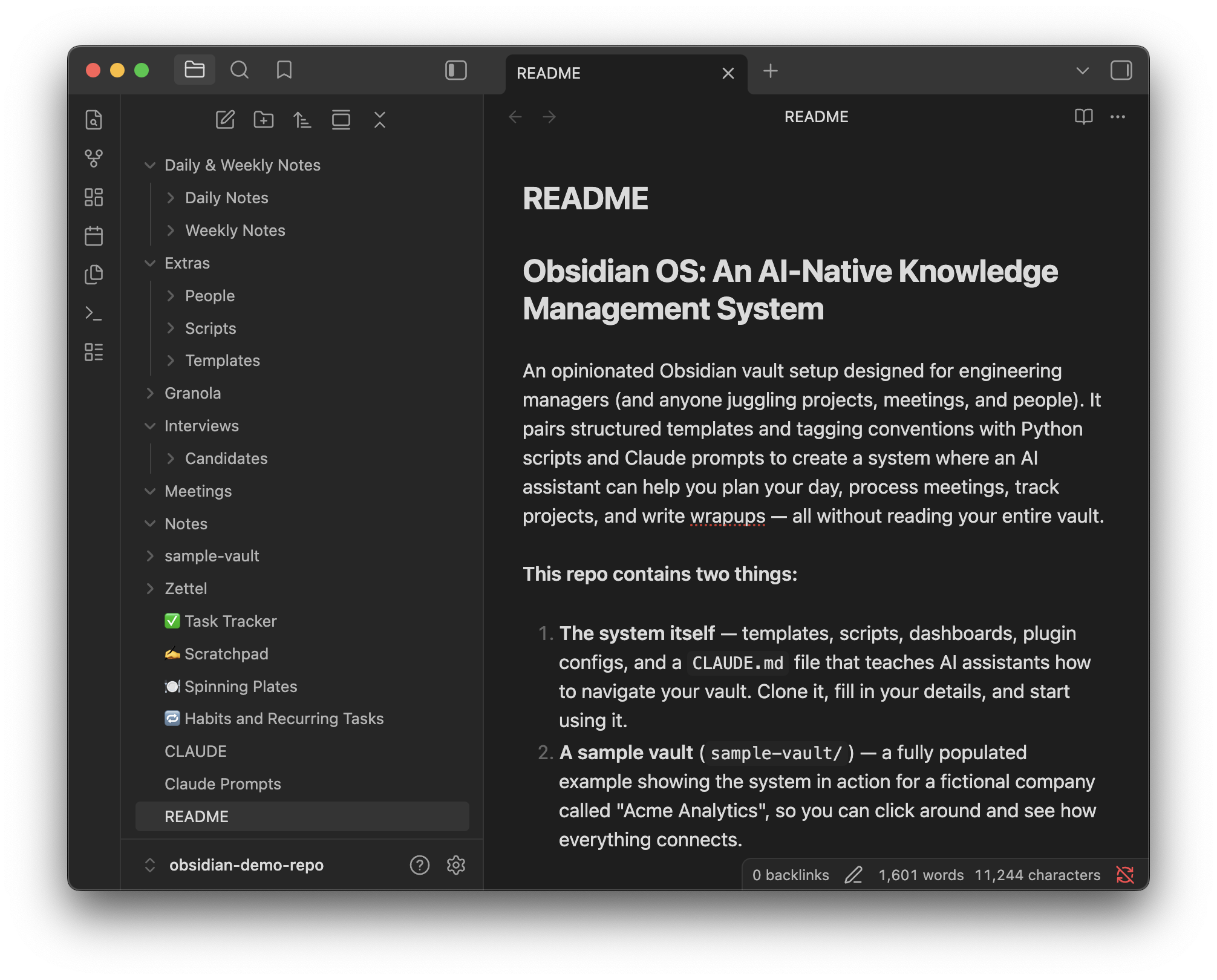
I’ve published a template vault. It has all the templates I use, the CLAUDE.md that orients the LLM, and even the prompts I use to start and end my day. You can open that as an Obsidian vault, or the ‘sample-vault’ folder to see it in action with some fake data. The README is pretty good and lists all the plugins I use to automate things like creating meeting notes and such.
If you want to try this, my advice is: don’t start with the AI. Start with Obsidian and a note-taking habit. Get the structure right. Get everything in there in a consistent format or tagging, even if you skip the planning sessions. Build the bones. The AI part is trivial to add later, and it’s dramatically more useful when it has something well-structured to work with.
And if you’ve already built that system and you’re not keeping up with it — that’s not failure. That might just mean you haven’t found the right executor yet.